
SHINJUKU GUIDE
A unique thing to do in Shinjuku: conveyor-belt wanko soba
For a uniquely Japanese experience in Shinjuku, try wanko soba, the endless-bowl soba tradition from Iwate, at Kurukuru Wanko in Kabukicho, where one-mouthful bowls of soba come to you on a revolving lane.
It takes 40 minutes, costs ¥3,800 per person (tax included), and is a 1-minute walk from Seibu-Shinjuku Station and a 4-minute walk from Shinjuku Station.
It is indoors and open every day from 11:00 (last entry 18:30), so it works rain or shine.
Updated: Published: Kurukuru Wanko

Why it is a unique thing to do in Shinjuku
Wanko soba is a traditional way of eating soba from Iwate Prefecture in northern Japan: tiny bowls, one mouthful each, eaten one after another. Here the meal itself is the activity.
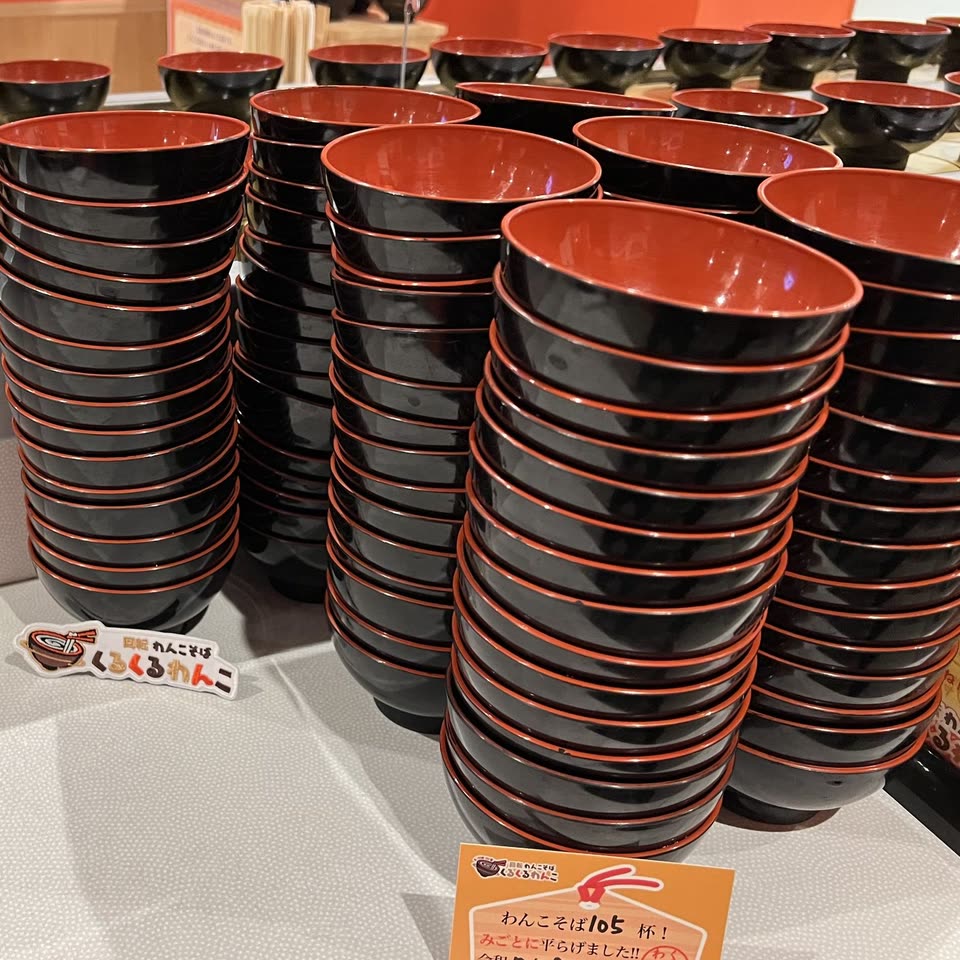
At Kurukuru Wanko, the bowls circle the counter on a revolving lane. You take a bowl, slurp it, stack the empty one beside you and reach for the next. The stack in front of you is your score.
Plan a half-day of Japanese cultural experiences in Shinjuku
What to expect
- A standing counter with 12 spots (no seats), and one-mouthful bowls of soba passing in front of you.
- 40 minutes, all you can eat, with no limit on the number of bowls.
- Rewards for big counts: an original patch at 100 bowls, a gold patch at 200 bowls and a gold medal at 300 bowls.
- Monthly champions (the top man and the top woman each month) receive ¥10,000 each.
- If you come in a group of three or more, whoever eats the fewest bowls drinks the bitter “penalty tea”.
- The all-time record is 925 bowls. The day's best count is shown on a monitor in the restaurant.
- Japan's first rotating wanko soba restaurant.
- No age restriction. Children who have not yet started elementary school eat free when sharing a seat with a parent or guardian, limited to one child per adult. Additional children, or a child using a separate seat, are charged for one seat. Elementary school children and older pay the regular adult price (¥3,800 per person).
How long it takes and how much it costs
- Time
- 40 minutes of eating
- Price
- ¥3,800 per person, tax included
- Hours
- 11:00–18:30 (last entry), closing at 19:30, open every day
- Booking
- No phone or in-person reservations (walk-ins in order of arrival, ¥3,800 at the door). You can book online on Asoview, Activity Japan or Klook (timed entry, ¥4,700).
A good plan for a rainy day
Kurukuru Wanko is indoors, on the 5th floor of the J-Gold Building in Kabukicho, a 1-minute walk from Seibu-Shinjuku Station and a 4-minute walk from Shinjuku Station. That makes it an easy plan for a rainy day in Shinjuku.
How to fit it into a day in Shinjuku
- Start at the stationWalk 4 minutes from Shinjuku Station, or 1 minute from Seibu-Shinjuku Station.
- 40 minutes of wanko sobaCome up to the 5th floor of the J-Gold Building, 1-22-9 Kabukicho. Last entry is 18:30, so it works well as lunch or an afternoon stop.
- Explore KabukichoAfterwards, walk around Kabukicho and look up for the Godzilla Head on top of the Shinjuku Toho Building.
Languages, dietary needs and access
- English-speaking staff are here every day. We also have Chinese and Korean menus.
- Halal-friendly: halal-aware staff are always on site, and our ingredients have been checked.
- Our regular broth uses bonito (fish) stock; a vegetarian and vegan broth is also available. Just ask our staff.
- Buckwheat and wheat flour are used, so it is not suitable if you have a buckwheat allergy.
- Wheelchair accessible.
- Private hire: ¥38,000 per hour. Please call +81-3-6265-9881.
Access
- Address
- 5F J-Gold Bldg, 1-22-9 Kabukicho, Shinjuku-ku, Tokyo 160-0021
- Stations
- 1 min walk from Seibu-Shinjuku Station (main exit); 4 min walk from JR Shinjuku Station (east exit)
- Hours
- 11:00–18:30 (last entry), closes 19:30, open every day
- Phone
- +81-3-6265-9881
- Landmark
- 1 min walk from the Godzilla Head (Shinjuku Toho Building)
Online booking sites
Book a time on one of these online booking sites (¥4,700).


FAQ
- How long does it take?
- The all-you-can-eat session is 40 minutes.
- How much does it cost?
- ¥3,800 per person (tax included) for 40 minutes, all you can eat.
- Do I need a reservation?
- We don't take reservations by phone or in person; walk-in guests are served in order of arrival. You can book online via Asoview, Activity Japan and Klook (¥4,700 for a set time; ¥3,800 at the door).
- Are there seats?
- No. It is a standing counter with 12 spots and no seats.
- Is it a good thing to do in Shinjuku on a rainy day?
- Yes. It is indoors, a 1-minute walk from Seibu-Shinjuku Station and a 4-minute walk from Shinjuku Station, and open every day from 11:00 (last entry 18:30).
- Do the staff speak English?
- Yes. English-speaking staff are here every day, and we have Chinese and Korean menus.
- Can we book the whole restaurant for a group?
- Yes. Private hire is ¥38,000 per hour. Please call +81-3-6265-9881.
See the live waitOpen in Google MapsStep-by-step directions
More guides
- Japanese cultural experiences in ShinjukuSpend half a day in Shinjuku with a Japanese garden, a regional food tradition and a tea ceremony. Start at Shinjuku Gyoen, try Iwate’s bite-size wanko soba at Kurukuru Wanko in Kabukicho, then head to the Sho-Fu-An tea room in Nishi-Shinjuku. If the garden is closed, start at Hanazono Shrine instead.
- What is wanko soba?Wanko soba is a way of eating soba from Iwate Prefecture in northern Japan: small bowls, each holding a single mouthful of noodles, are served one after another, and you eat as many as you can.
- Halal-friendly food experience in ShinjukuKurukuru Wanko, a conveyor-belt wanko soba restaurant in Kabukicho, Shinjuku, is halal-friendly: halal-aware staff are on site at all times, and our ingredients have been checked.
- A fun lunch in Shinjuku & KabukichoFor a unique, traditional Japanese food experience in Shinjuku, try wanko soba at Kurukuru Wanko in Kabukicho — Japan's first rotating (kaiten) wanko soba restaurant.
- Things to do in Shinjuku on a rainy dayOn a rainy day in Shinjuku, Kurukuru Wanko in Kabukicho is an easy indoor plan: it is on the 5th floor of a building a 1-minute walk from Seibu-Shinjuku Station (4 minutes from the east exit of JR Shinjuku Station).
- All-you-can-eat in Tokyo for ¥3,800Kurukuru Wanko in Shinjuku, Tokyo, is a 40-minute all-you-can-eat for ¥3,800 per person (tax included, walk-in): Japan's first rotating wanko soba, where one-mouthful bowls of soba come to you on a revolving lane.
- Unique food experiences in TokyoFor a unique food experience in Tokyo, pick by what you want to do: cook monjayaki yourself on a griddle in Tsukishima, walk the stalls of Tsukiji Outer Market, make a replica food sample in Kappabashi, eat yakitori in the post-war alleys of Omoide Yokocho, or try a game-like regional dish such as wanko soba.
- Traditional Japanese food in Shinjuku & KabukichoIn Shinjuku you can try traditional Japanese food in several styles: yakitori and grilled offal in the post-war alleys of Omoide Yokocho, quick standing soba counters, department-store food halls (depachika), the Kabuki Yokocho food hall in Tokyu Kabukicho Tower, and wanko soba, a regional soba tradition from Iwate.
- All-you-can-eat lunch in Tokyo: how to chooseAll-you-can-eat (tabehodai) in Tokyo comes in many types: yakiniku and shabu-shabu where you cook at the table, sushi, hotel lunch buffets, dessert buffets, and wanko soba. Most have a time limit, and drinks are often charged separately, so check the time, what is included and whether you need to book.
- Food experiences in Tokyo for families with kidsFamilies with children in Tokyo often enjoy food experiences where kids can do something themselves: cooking monjayaki on a griddle in Tsukishima, making a replica food sample at a workshop in Kappabashi, picking plates at a conveyor-belt sushi restaurant, or taking bowls from a revolving lane at a wanko soba restaurant.
- Wanko soba historyWanko soba is a traditional way of eating soba from Iwate Prefecture: one mouthful of noodles in a small bowl, eaten one bowl after another. Hanamaki is known as its birthplace, and it is said to have begun about 400 years ago, in the early Edo period.
- Japanese food culture experiences in TokyoWashoku, the traditional food culture of Japan, was added to the UNESCO Intangible Cultural Heritage list in 2013. In Tokyo you can experience it through sushi making, tea ceremony and wagashi, markets, kaiseki and regional dishes.
- How many bowls of wanko soba?Across 5,019 recorded 40-minute challenges at Kurukuru Wanko (May to October 2026), the average was 125 bowls and the median was 117.
- Kurukuru Wanko home